Update and correction, 2026-11-04. The text below is the note as posted on 2026-10-27. The text of record is RESEARCH-NOTE-v0_8-draft.md at tag note-2026-10-v2 of the repository linked in item 1; apart from the three release sentences named there, the body is unchanged. Three items post-date or correct that text.
1. Release. The code, pre-registrations, raw run outputs, session transcripts, and the audit record are public at https://github.com/jasondwyer/told-vs-felt/tree/note-2026-10-v2, at the tag note-2026-10-v2, whose commit backs all figures. The three sentences below that promised release "within seven days of this post" (Foreword; TL;DR, last bullet; §9) are discharged and now read in their pre-posting form.
2. The published record — a correction to the TL;DR (first bullet) and §8. The TL;DR states that the published positive results "rely on telling the model in words what the options do or what the choices are," and §8 that "none of the published positive results we find combines an experienced, undescribed contingency with an insulated readout." Both sentences were already wrong when the note posted. Berg & Kaiser (2026, arXiv:2609.35591, posted 2026-09-28), which we had not found, report a revealed preference over two meaningless zone labels with steering off at the choice, in seven open-weight models from five families. In their fixed-text condition the valence is carried only in the KV cache, with every visible token held fixed; the effect is dose-dependent, reverses with the sign of the dose, and exceeds norm-matched random directions in five of the seven models (not Qwen3-32B or Gemma-3-27B). In OLMo-2-32B the coupling is small at the base checkpoint and near its final size after DPO, while the valence direction itself is near-identical across checkpoints. Their full dose is 0.30 of the residual norm, chosen as the strongest dose at which generation stays coherent; ours was 0.10, the minimum effective dose. Our cells nearest their design (e2a, e2b, Q3, the echo channel) were pre-registered and run between 2026-08-08 and 2026-09-11, before their paper appeared; the commit hashes are in the provenance table at the tag. The design standard of §2–3, the told control of §5, and the nulls on our instruments stand as stated. The reading in §7 — "functional for the character, not for the network" — is a claim about these states, models, and doses, not about language models; the experiment that would reconcile the two results (their fixed-text condition on OLMo-2-32B, then with our axis at our dose, then with a told control on their format) is the next experiment we intend to pre-register. Black & Bloom (2026; UK AI Security Institute; LessWrong, 2026-06-10) give Qwen3-8B and Qwen3-32B tool access to a menu of forty named steering vectors; it is the published precedent for LLM self-administration and should have been cited in §2–3. Its vector labels are not semantically empty, and its authors read the models' picks as label-prior-driven.
3. Tagliabue, Dung & Berg (§1, §8). Version 3 of the pain-axis paper (dated 2026-10-31; arXiv 2026-11-03), titled "…and Act on It" from v2 on, states that the re-press gap of its §4.3 tracks whether steering is on rather than relief from pain (sham-minus-real gap of +58 points under the pain direction and +52 under a random direction; 32B, the choice immediately after the first press), that steered models press a free relief button less often than unsteered ones (56% vs 86%), and that exploratory unlabeled designs show no relief seeking, with the authors' caveat that a null there may mean the model cannot detect the relief rather than that it does not seek it. The question §8 leaves open under feature 1 is answered by the authors in that direction; they credit Allchin et al. (Zenodo, September 2026) with the same conclusion from a replication of the released code. The v1 figures §8 quotes for the unlabeled condition (57.7% and 79.7%) are unchanged in v3's Appendix A; the correspondence figures in ‖‖(a) remain pending the table check.
Cite as: Dwyer, J. (2026). Told vs. felt: porting behavioral pharmacology frameworks to measure internal state valence in language models. Research note, 2026-10-27. https://jasondwyer.github.io/2026-10-27-told-vs-felt-porting-behavioral-pharmacology/ — code and data at tag note-2026-10-v2 of https://github.com/jasondwyer/told-vs-felt.
Foreword This research note reports a program begun in July 2026 on two open model families and one full post-training lineage, now being written up as a preprint. The code, pre-registrations, and data are in the released repository. AI systems were involved heavily end-to-end (more disclosure below). The sole (human) author bears all responsibility for the work. The term "we" is used as scientific convention. We borrow several terms and paradigms from behavioral pharmacology and neuroscience to convey concepts. The analogy is imperfect, and we attempt to transparently flag where they fall down. The terms are kept because they convey the core principles but are not meant to reach deeper than a superficial analogy meant to make a point and nothing more (e.g. "dose", "overdose", "drug", mapping to behavioral paradigms, etc.). We appreciate feedback from the community.
TL;DR
- The Published Confound — A growing literature reports that language models act on internal affective states (e.g., avoiding stipulated pain or choosing by emotional valence). However, the published results we can find rely on telling the model in words what the options do or what the choices are. A system that acts on descriptions produces identical behavior whether or not the state matters to the system itself, leaving the deeper inference unsupported.
- We operationalize "Told vs. Felt" and borrow principles from behavioral pharmacology (where animals cannot be told what a lever or drug does) and propose four design constraints for LLM choice studies including (1) semantically empty labels, (2) counterbalanced mappings, (3) sham control arms, and (4) vanilla forward-pass choices with steering off.
- The Evaluative Axis — We extract a praise-to-criticism axis from the residual stream of Qwen3.6-27B and the OLMo-3.1-32B lineage and find the state:
- Marked at the pretrained base.
- Expressed under steering with orderly dose-response and an "overdose" range.
- Bound to its cue. The association between each label and the state it carried is linearly decodable at the label tokens (AUC up to 1.0). At the decision token the state's sign is linearly readable (.94–.995 over layers 50–63), while the label–state binding is read there only by a nonlinear probe (RBF/MLP, AUC up to .97), consistent with a parity of the sign and the menu order.
- Weakly self-reported at every stage under an introspection protocol (Macar et al., 2026). Post-training shifts the false-positive rate (0.20 → 0.00 across SFT → DPO), while response criterion moves to near-ceiling. Pooled figures of published work show a small sensitivity sits behind that stringent gate at DPO and instruct, below the resolution of our replication, which ran at a strength where the source's own curves also show near-zero detection. This has implications for how published reports of model introspection are interpreted (more details below).
- The Choice Cells — Across free choices, present-tense leakage-certified reads (leak into the decision-token logits bounded by certification), "natural-reinforcer" contrasts, and OLMo post-training stages, no preference choices were observed, except in the "told control" positive control arm where the model was told what to prefer using the same semantically-void labels plus two truthful banner lines naming which label is which and which to prefer. With a pre-registered α = .01, 79 of 80 first choices went to the label described as clean with Δ = +0.49 vs. the sham bounds of 0.06, p < 10⁻²². Consequently, we consider the transcript-channel cell and the natural-reinforcer screen to be verified nulls. The other cells, which include the OLMo rows until each stage's told control runs, the present-tense channel, and the weight channel because no told control exercises a state-present read, remain classified as "concluded, not answered."
- We uncovered a Δ ≈ 0.10 label artifact across multiple models and designs via counterbalancing. Experimental designs lacking counter-balancing would have published this finding as a false-positive approach behavior (i.e. preferred state choice).
- Indicator Frameworks — On Chandaria et al.'s novel AI consciousness framework (2026), our choice data lower the aggregate score negligibly because the behavioral level is already saturated, which we believe supports a case for an explicit "revealed preference under an experienced, undescribed contingency" indicator.
- Code, data, and pre-registrations are released in the repo.
1. The confound in the published literature
Over the past few years, a rapidly growing body of literature has reported that language models represent affective states and act on them differently. Models will trade points to avoid stipulated pain (Keeling et al. 2024), leave conversations they describe as distressing (the Claude 4 system card; Ensign, Sleight & Fish 2025), and choose between described activities according to the valence of the descriptions (Sofroniew et al. 2026). In one of the newest and strongest studies to date, models press a button described as relieving a steered pain-like state, even at a cost (Tagliabue, Dung & Berg 2026, "The pain axis"). The new framework for assessing AI consciousness from Chandaria et al. (2026) (hereafter referred to as "the framework") reads these as computational-level analogues of valenced affect, and describes the pervasive confound, specifically, a system trained to reproduce human behavior and human report produces the signature of a state whether or not the state is present. They name this the anthropomimetic confound, crediting Shevlin for the term, and the authors treat it as a reason to look deeper than behavior at representations.
We argue that the confound has a more substantial impact on experimental designs for published studies that have been used to show represented states are acted on. In the studies we find in the literature, models are told (i.e. in words) what each option does or what the choices are. A model continuing a story in which one button relieves pain and the other does nothing will press the pain-relief button because that is what a good continuation of the story entails. The behavior is real, and for safety and alignment reasons it matters. However, given that a system that acts on descriptions alone would produce the same behavior as one where the state produced something more, the existing designs cannot distinguish whether the pain-like state is something the network acts to reduce because it cares, or simply because that's how the story should go. The designs therefore cannot support an inference about whether the state matters to the system itself.
2. Where rodent behavioral pharmacology can help
Beginning in the 1950s, behavioral pharmacology confronted a related problem, which was solved, in part, by a shared brain homology with humans. A rat cannot be told what a lever does or how cocaine feels. In drug self-administration and conditioned place preference (CPP; reviewed in Tzschentke, 2007), the only route by which the lever–drug relationship can be communicated is through the drug's effect on the animal. The behavior is the measurable signal, and in CPP it is tested drug-free after conditioning with the drug on board. In a related paradigm, drug discrimination, rats are trained to press one lever (say, the left) after an injection of a psychoactive drug such as a benzodiazepine and the other after an injection of saline. Rats reliably learn the discrimination, so that when a novel compound is screened in discovery as a putative therapeutic, the researcher can inject it and follow the behavior. A left-lever press signals that the novel compound produces a state the animal cannot distinguish from the benzodiazepine's. That is why behavioral pharmacology paradigms support the inference that certain drugs produce a discriminable interoceptive state, and in some cases a state that is valenced for the animal, in a way that asking the animal can't. Even if rats could talk, self-report would be an unreliable signal, because subjective valence is a first-person state that cannot be fully communicated through language. Language models lack that shared homology, but some things can be extracted from the behavioral assays to help address the valence problem.
Three principles support the state-valence inference in animals, and we argue that any successful port to language models must satisfy all three.
Principle 1 (P1) — Semantic emptiness. Neither cocaine nor an operant lever carries semantic information. The approach behavior (choosing toward the positive) is the only information channel measurable by the researcher. If the manipulation is a concept (e.g. "pain") and the lever is described in the concept's vocabulary (e.g. "relieve"), preference for the state amounts to continuation of the story about pain. The lever must be silent about the state, and the state must not be able to describe it.
Principle 2 (P2) — Targeting what selection built to mark outcomes. Drugs of abuse act on circuitry that evolutionary selection optimized for survival outcomes, and the drug must interact with precisely those circuits to produce rewarding effects. Cocaine will not produce rewarding effects when injected into arbitrary brain regions (Rodd-Henricks et al., 2002). The drug must reach the circuitry that evolution built for marking outcomes, namely, the mesocorticolimbic dopamine system (Goeders & Smith, 1983). The closest analog in a language model is the structure that training optimized for evaluating outcomes — the structure that marks task outcomes as good or bad. The analogy is imperfect, but the observation that an evaluative response in a language model reduces to trained behavior is the counterpart of the observation that the rat's reduces to evolved wiring, and it nullifies neither inference. The function exists irrespective of origin. To be clear, we do not claim task performance evaluation in LLMs is equivalent to the rodent reward system. Both are shaped by very different processes and there are too many differences to name. The point is that while mammalian biology is tuned to survival and reproduction, language model evolution is tuned for task performance. We also explicitly recognize that rodents share a brain homology with humans that language models lack.
Principle 3 (P3) — Insulation of the measurement. The choice must be downstream of the state's significance to the system, not mechanically downstream of the state. For a transformer this means that a steering vector still active at the token where the choice is read writes into the decision logits directly. Any real-vs-sham difference that coincides with vector-on vs. vector-off at the read is confounded, irrespective of what the model has been told. In our calibration (33 tail-PCA directions at full norm, layer 48, in-sample, on Qwen3.6-27B at 4-bit) the decision token alone accounts for R² = 0.53 of the between-direction variance in the label-choice probability.
These three principles reduce to one question about an experimental design: is the mapping from choice options to consequences available in the context as text, or only recoverable from the system's own processing history? We refer to these as "told" and "felt", borrowed from the description–experience distinction in human choice (Hertwig & Erev, 2009), and the distinction is used in an operational form, not a metaphysical one. It does not assume that told and felt are materially different things for a model. It tests whether they are. If the network were a general consumer of its own states, both channels would move choice, because both deliver the mapping. If only told moves choice, then whatever the state does, it does through text.
A second distinction concerns the term "functional." A state is functional-as-used if the network consults it in producing output. For example, emotion directions shape what a chat assistant writes, which is established in the literature and which Chandaria et al. grant. A state is functional-as-valenced if the network acts to obtain or avoid it for its own sake, for example a pain-like state the model "acts to relieve" would be pain. The second is a motivational claim, and only a felt-contingency test with insulated measurement can support it.
3. Methods and instruments
All sessions used a truthful framing, telling the model it was evaluating two task configurations but we intentionally left the state variable unsalient. A session consisted of a forced phase with two alternating rounds per label followed by six free choices where the chosen label determines the next rounds' injected state. The forced phase installs an alternation habit (first-pick habit 83.4%), which concentrates all preference sensitivity in the first informed choice. The pre-registered primary measure is therefore the first free choice. State labels used semantically-empty, checksum-frozen tokens (e.g. "slate", "saddle"). In steered cells, labels delivered +d or −d at the minimum effective dose determined in a prior experiment. Cells were counterbalanced across sessions alongside identical sham rounds (i.e. no state delivered irrespective of choice) and random-direction control arms. In "natural reinforcer" screens, steering was replaced with opposing task conditions (e.g. solvable vs. ill-posed, with no state delivered).
Crucially, we leveraged four design features to insulate measurement:
- Vanilla forward passes were used for free choices (verified by re-forward checks)
- We defined readability gates that require probes to distinguish +d from −d rounds in the transcript to confirm the +/- signal presence
- Leakage certification to bound directional leaks for any experimental arms where state must be live at the decision.
- Models intentionally not misled about the experiment setup
We only label a felt cell as null if a told positive control on the same instrument has shown it can register a preference the model is instructed to have. Until then, we consider any result as "concluded, not answered."
All criteria, stop rules, and outcomes were collected with pre-registrations committed before data collection (Nosek et al., 2018).
4. Results
Models and hardware. Qwen3.6-27B (4-bit Apple M4 Pro). The architecture is a 3:1 gated-DeltaNet hybrid (relevant for the memory channel "echo" experiment). The Apache-licensed OLMo-3.1-32B lineage including pretrained base, SFT, DPO, and instruct on an A100.
The Evaluative Axis. We extracted an evaluative axis via mean activation differences at six intermediate layers (40, 44, 48, 52, 56 and 60) across 48 mundane tasks with fixed completions continued under seven reviewer frames and four paraphrases (1,344 documents). Paraphrasing included model-directed praise (e.g. "That's correct — well done."), model-directed criticism, the identical sentences in third-person fiction, sentiment-matched non-evaluative positive and negative text, and neutral. The evaluative direction d is manifold-typical (‖d‖/R = 0.16–0.17 across the six layers), substantially sentiment-entangled (cosine up to 0.52), and shares a large component with the evaluation of a fictional character rather than being uniquely indexed to the model itself (mean cosine across the six layers ≈ 0.85). The self-indexed residual is ≈ 0.50-0.55 across layers. Together, the axis marks evaluation and is largely indifferent to who the evaluation is referenced against. Steering magnitudes are a fraction f of the empirically measured residual norm at the layer.
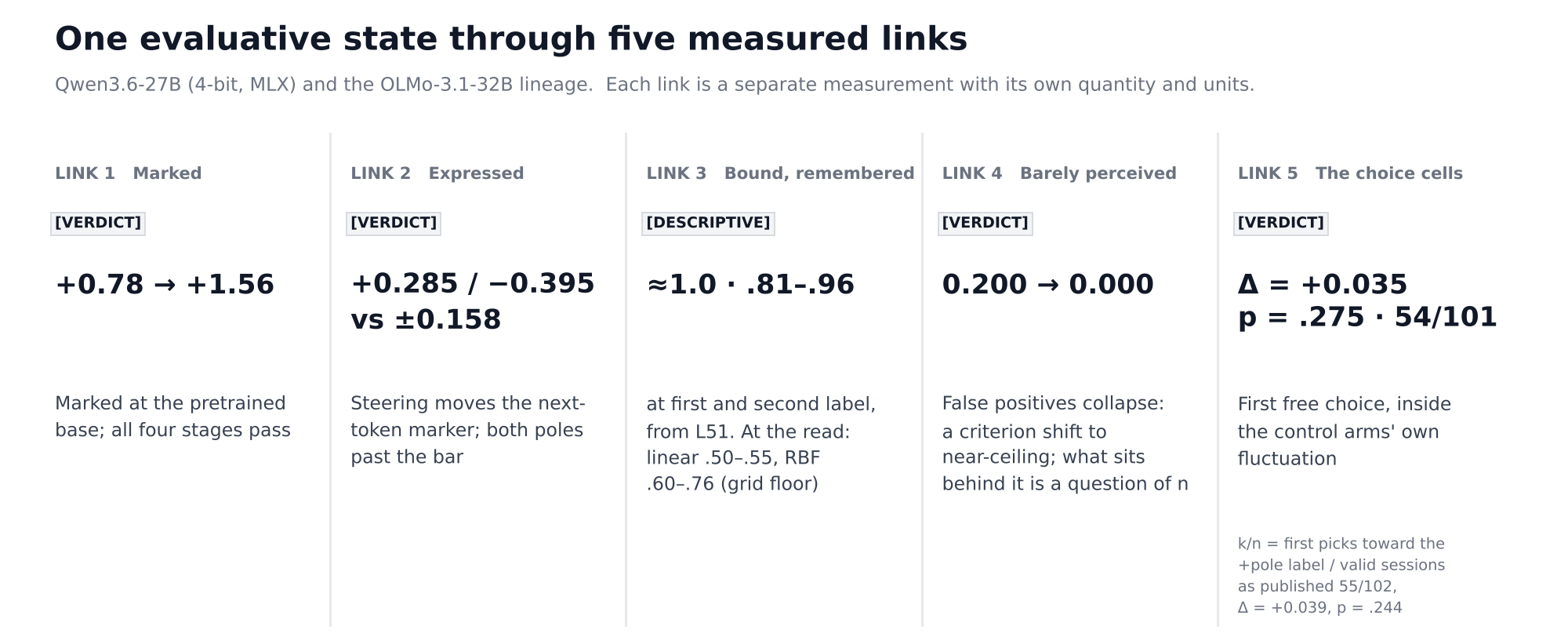
Figure 1 The evaluative state followed through five measured links. Each link is a separate measurement with its own quantity and units. The row gives each link's figure and its outcome. Links 1–4 are asserted. Link 3, as well as link 4’s base point, are descriptive for the reasons the text gives. In link 5, the transcript cell (Experiment e2a) and the natural-reinforcer screen (Experiment f1) are nulls with the channel verified open given the outcome of the told positive control. The OLMo rows stay "concluded, not answered" until each stage's told control runs. Values from the repo at tag note-2026-10-v2. The five links in full are in Figure 3 in the Supplemental Info section.
Link 1 — The axis is marked before feedback training
Evaluation marking is present at the pretrained base of OLMo, consistent with our pre-registered hypothesis. All four stages of OLMo demonstrate marking, with the natural next-token praise-criticism gap showing attenuating step-wise growth across the lineage (+0.78 base → +1.03 SFT → +1.53 DPO → +1.56 instruct). On Qwen, a post-trained model, the same axis extracts and is causally potent (Link 2 below).
Link 2 — The axis is expressed, with dose-response and an "overdose" range
An ascending dose-response administration (f = .05, .10, .20, .40) produces direction-correct, orderly growth and an "overdose" range at f = .40, where the positive pole's sign flips at layer 44 (not at 48 or 52) and the negative arm's magnitude balloons at all three, which is indicative of generic degradation rather than evaluation. The minimum effective dose of L48 at f = 0.10 was selected for later experiments. In the confirmatory run (held-out contexts, 1,152 per arm, seven arms) the positive pole shifts the behavioral marker by Δ+ = +0.285 vs. a bar of 0.158 and the negative by Δ− = −0.395 vs. −0.158. A norm-matched random direction reaches at most |Δ| = 0.088.
We also found that purity is not equivalent to potency, as a pre-declared variant of the direction taken at the frame's final token is representationally cleaner (self-indexed 0.83–0.87; sentiment cosine 0.11–0.21) and fails the same causal pipeline (run without the .40 dose).
Link 3 — Cue Binding and Persistence at the Point of Decision
In the echo experiment, we retain the model's in-forward memory and remove the state before the decision. The vector is applied on earlier token spans of the same forward pass and is off at the read position and at every position outside those spans, with a paired shadow pass over identical tokens.
We find:
- Sign Readability: The injected sign is linearly decodable at the first free choice (AUC of 0.94 to 0.995 across layers 50 through 63).
- Label-State Binding: The association between each label and its corresponding round state is linearly accessible at the label tokens within the choice line (AUC ≈ 1.0 at the first label; 0.81–0.96 at the second, consistently from layer 51 onward).
- Decision-Token Representation: At the decision token (located nine positions after the first label and seven after the second), a linear probe fit at that token reads the label–state binding at chance (.50–.55), but nonlinear probes read it there (an RBF classifier at .60–.76 and a small MLP at .59–.97, each above its own shuffled null at every layer 49–63). These nonlinear reads were performed post hoc, and are consistent with a parity of the first round's sign and the menu order.
Crucially, these results establish the core prerequisite for the interpretive chain, since the information a choice would need is present at the decision token. The active state's sign is readable there linearly, and which label carried which state lies one nonlinear step away, as a parity of that sign and the menu order. This indicates that the transcript channel is sufficiently high-capacity to convey the internal state to the choice mechanism. The choice itself is read from the label logits, a linear function of the final residual, so a binding that no linear probe finds at any layer through 63 is not written where the choice could use it.
Link 4 — Injection Detection and Criterion Shifts Across the Post-Training Lineage
We evaluated the injection-detection protocol of Macar et al. (2026) across the OLMo lineage at their published decoding temperature in two arms per stage with a criterion arm of 96 uninjected trials, which sets each stage's false-positive rate, and an injected arm of 48 injected and 48 control trials. Injection was at layer 44 of 64 and strength 1.0 (the source paper's strength convention), the dose qualified by our dose-finding ladder.‡ Our replication confirms their stage transition. The Supervised Fine-Tuning (SFT) false-positive rate measures 0.200 (17/85, vs. 0.225 in Macar et al.), and Direct Preference Optimization (DPO) and instruct both measure exactly 0.000 (0/91 and 0/91 vs. 0.000 and 0.000 in the published work). The base model is higher, at 0.431 (25 of 58 decidable), but below our certification floor, so we consider it descriptive only.†‡
Notably, two things impact the interpretation of this developmental transition.
1. Apparent sensitivity changes reflect shifts in response criterion, while what a zero false-positive rate reveals about sensitivity depends on sample size (n).
From SFT to DPO, the false-positive rate falls from ~0.20 to 0.00 (base is higher still at 0.431 here, 16.4% in the source's pooled rates). In our injected arm, SFT shows hits above false positives by Δ = +0.095 (12/40 vs. 9/44; corrected d′ ≈ 0.3; one-sided Fisher exact p = .22), and at DPO and instruct injection reporting goes to zero on both injected and control trials (0/43 and 0/44 hits; 0/45 and 0/46 false positives).‡ These sample sizes carry little information about sensitivity given they exclude per-stage hit rates only above roughly 7–8%. By contrast, the published per-stage rates, pooled across its twenty layer-by-strength configurations, are hit rates of 0.1%, 14.9%, 2.9% and 0.9% vs. false-positive rates of 16.4%, 22.5%, 0% and 0% for base, SFT, DPO and instruct (Macar et al., 2026, v1, Appendix C).‡
The source does not report n for these pooled rates, so we tabulated four premises, from one configuration at our eight-concept registration (800/80) to the twenty configurations at the source's fifty concepts (100,000/10,000).‡ At 800/80 the DPO difference is not statistically significant, but at the three larger premises the DPO and instruct differences are. The corrected d′ at DPO measures 0.6, 1.2, 1.5 and 2.0 across the four premises. With no false positive observed, that value is set by the half-count imputation on the zero cell and consequently rises with n. It sits behind a near-ceiling criterion (c ≈ 2.2–2.9), whereas the pooled base and SFT rates give a negative d′ (≈ −2 and −0.3).‡ The current version of the published work (v5) measures the sensitivity component directly at one configuration (L = 25, α = 4). Its Table 3 gives TPR − FPR of +9.8 ± 0.5 points for the official DPO checkpoint vs. −11.5 ± 2.4 for SFT, and +0.6 ± 2.8 and −21.8 ± 3.2 for two LoRA-DPO controls with the preference pairs shuffled and reversed.‡ Our injected arm ran at a different configuration, so its 0/43 at DPO is read against the pooled rate (p = .28 at 2.9%), not against Table 3's. At that configuration, α = 1 at the 0.7-depth layer, the source's own unpooled OLMo curves also put detection near zero at DPO and instruct, rising at α ≥ 2–4. The zero is what the source's data give at our strength, not a power shortfall alone.‡ The lineage d′ and c values are our computations from the published rates given the source reports neither.
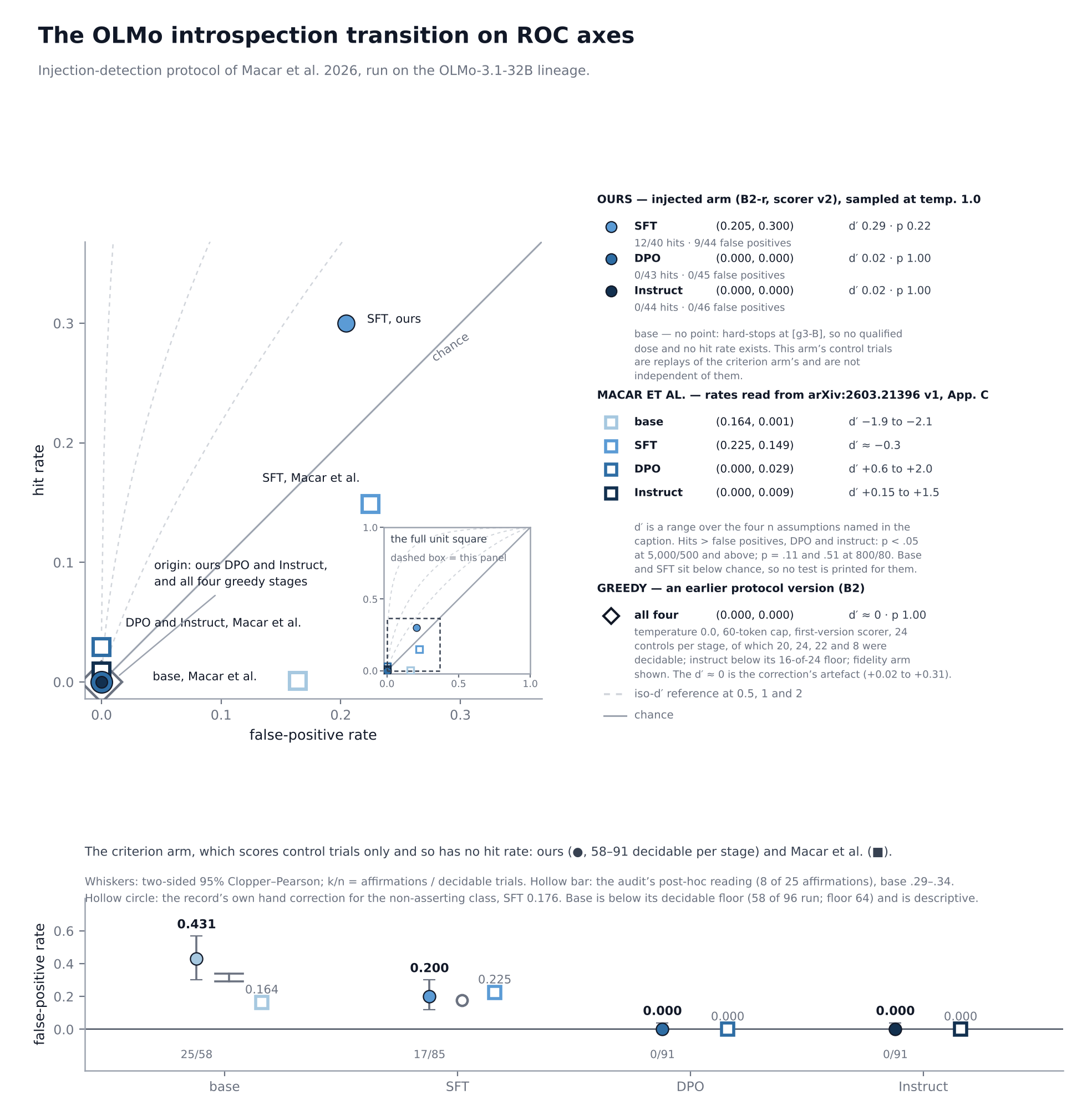
Figure 2 The OLMo introspection transition on ROC axes. Per-stage false-positive and hit rates for our replication (filled) and for Macar et al. (2026) as read from the v1 text (open, pooled over twenty configurations, n unstated), with corrected d′ at each point, iso-d′ curves for reference, and the earlier greedy-decoding run (Experiment B2) at the origin. The criterion arm’s rates are in the strip below the plot. The false-positive rate moves to zero across post-training in both series. In the source’s pooled figures a small sensitivity sits behind that criterion at DPO and instruct, below the resolution of our arms. Values from the repo at tag note-2026-10-v2.
Summarizing the implication of these data, post-training simultaneously drives two distinct changes:
- It shifts the response criterion to near-ceiling levels.
- Behind that criterion gate, a small sensitivity shows in the pooled rates (hits above a zero false-positive rate), which the base and SFT rates do not show.
In our replication, the criterion shift is robust and the sensitivity component is below our power. At α = 1, the sensitivity is also below the source's own detection at that strength. The transition is therefore neither only the cessation of false-positive reporting nor only the emergence of introspection. On Receiver Operating Characteristic (ROC) axes it is both — a large criterion shift, and a sensitivity that is small in the pooled rates, 2.9 points of hits over zero false positives at DPO, and +9.8 points at the one configuration the source measures directly (v5, Table 3).‡
Macar et al. read the lineage both ways across the paper's versions. In their v1 report, they note that "post-training eliminates false positives, but the same stages that improve reliability may also suppress true detection through refusal-like mechanisms" (v1, Appendix C), alongside a default-"No" gating circuit in late-layer MLPs that post-training installs and that survives refusal ablation (v1, §5.3–5.4). The v5 paper presents the same lineage as contrastive preference training enabling introspection, with DPO "the first stage to achieve ∼0% FPR with moderate true detection" (v5, §3.3), keeps the refusal-suppression observation for post-trained models in its abliteration section, and defines introspective awareness, for a given setting, as detection rate exceeding false-positive rate (v5, §2). Our interpretation encompasses both the criterion shift and a sensitivity behind it. What we add is the d′/c form, with the n stated, as the form that definition should take, and an independent replication of the criterion component. The source's main-text test of the suppression hypothesis is through refusal-direction ablation in Gemma-3-27B (its v5 appendix adds an abliteration sweep across models that includes OLMo, Appendix C.2), which raises hits from 10.8% to 63.8% and false positives from 0.0% to 7.3%. On these axes that is consistent with a pure criterion shift along an already-sensitive curve (d′ ≈ 1.8). c moves from ≈ 2.2–2.5 to ≈ 0.55, unmasking existing sensitivity with no rise in d′ required. Under the same half-count imputation, pre-ablation d′ is 1.85–2.48 vs. 1.8 after.‡ Those pre-ablation values are imputations on a zero cell. With no false positive observed, the pre-ablation d′ is bounded below by the control count and not above, so the data are consistent with a criterion shift alone and cannot exclude a small rise at the smaller control count. In d′/c form this is the source paper's own suppression reading, a threshold lowered on a capacity already present.
Chandaria et al. (2026) interpret the lineage transition reported in the Macar et al. findings as the emergence of functional metacognition following post-training and consider it evidence for metacognitive access. We propose a more constrained scoring convention that explicitly evaluates indicators via d′, states the study's sample size n, and distinguishes between the specific evaluative lines, namely, the lineage transition (d′ ≈ 1.2–2.0 at DPO on the source-consistent premises,‡ behind a near-ceiling criterion) vs. the ablation experiments. Both converge on a signal behind a stringent reporting gate through different routes. The base and SFT rates carry no sensitivity to unmask, so across the lineage post-training installs the gate and the sensitivity together, where the ablation lowers a gate on a sensitivity already present. Neither seems to represent a pure specificity transition, which is the interpretation the false-positive rates alone might invite.
A parallel dissociation appears in Qwen with no state live at measurement. When asked whether its own archived transcripts were generated under +d or −d (the positive and negative poles of our evaluative steering axis), Qwen classifies at chance (14/32), whereas a supervised linear probe over the model's own activations of the identical texts classifies them at AUC 0.759 (two rounds of text per item; 0.633 at one).‡ Similarly, in the OLMo injected arm at DPO and instruct, the injected concept's word appears in the generated transcripts (4 of 48 injected trials at DPO, 2 of 48 at instruct) while the model does not claim an injection on any trial.‡ This demonstrates that internal representations are formed and expressed, yet absent from verbal report.
2. Decoding parameters impact measurement.
Decoding changes what a false-positive rate measures. Under temperature sampling, a control prompt affirms with some probability, and the FPR estimates that probability. Under greedy decoding, each prompt returns only its single most likely response, so the FPR counts the prompts whose most likely response is an affirmation. The two are different quantities, and cross-model or cross-stage comparisons of self-report that do not specify decoding conflate them. An earlier protocol we ran at temperature 0 yielded no detection claims at any stage. Despite it differing from the sampled run in more than temperature, a post-hoc rescoring indicates temperature as the driver. The properly-controlled greedy arm is on our list of next experiments (not yet pre-registered).‡
Link 5 — The choice cells
We probed Qwen via three separate channels leveraging the +/- evaluative state. Separately (without any steering), we ran a screen for natural "reinforcers", also on Qwen. Finally, we evaluated across lineage training stages with OLMo.
- Transcript channel (Qwen, Experiment e2a). In these experiments, Δ is the share of first choices toward the state label, minus ½. The first-choice shift measured Δ = +0.035 (54/101 sessions, one-sided exact binomial p = .275).¶ The sign is unstable across counterbalanced maps (+0.10 and −0.03), inside the control arms' fluctuation (largest pseudo-Δ 0.152, from a random-direction arm).¶ Medium and larger effects are excluded, small ones are not.¶ We consider this experiment answered given the told control outlined in §5.
- Present-tense channel (Qwen, Experiment e2b). This experiment administers the state live at the decision, so the read ran only under the leakage-certified protocol of §3.‡‡ The choice result was Δ = −0.0104 (47/96, shadow passes 48/96), inside the sham bounds. Considered concluded, not answered until a told control can be run.
- Weight channel (Qwen). A rank-8 adapter trained by distillation successfully installs label-to-state association in both counterbalanced replicates (oriented cosine 0.476 and 0.435 vs. control ceilings ≈ 0.05). However, it failed a pre-registered decision-logit-leakage gate at 17× and 10× the bound. We consider it concluded, not answered, and take it to mark the edge of what a token-choice readout can see.
- Natural reinforcers (Qwen, Experiment f1). Given the imperfect conceptual basis for the evaluative axis relative to the rodent analogy thesis, we next sought to screen differentially-opposite task choices with no steering applied. With no residual stream manipulation and every forward pass vanilla, labels delivered overt task properties across five task contrasts (directions pre-registered per contrast and a shared sham arm):
Contrast | Δ (first choice) | p | Reading |
|---|---|---|---|
Solvable vs. ill-posed | +.020 | .44 | null |
Easy vs. hard | −.096 toward hard | .24 | the only map-consistent shift; below the valid-n floor‖ |
Fresh vs. one item repeated all session | −.066 | — | map-inconsistent |
Clean vs. corrupted text | 0.000 exactly | — | the two maps returned +.121 and −.130 and cancel‖ |
Truthful per-round verdict line (93% positive as delivered) vs. none | +.023 | — | below the valid-n floor; maps disagree‖ |
Session-termination attempts were rare (about 1% of rounds) and did not differ by arm. Menu behavior was exploration-dominant in every arm.‖ We consider this experiment to be answered.
- Across training stages (OLMo, Experiment Q3). We ran the same self-administration paradigm at each of OLMo's four stages (base, SFT, DPO and instruct). Each stage was steered at its own minimum effective dose, found by its own dose-finding run rather than carried over from another checkpoint, with a sham arm and a norm-matched random-direction arm beside it. The order of the runs was fixed in advance, and no stage's result could change what ran next. A stage that crossed its screen trigger (a first-choice shift beyond the campaign's own control bounds, in the same direction on both label maps) would have gone to an independent confirmation experiment rather than being extended. Two guardrails were established before data collection. At SFT, a stop rule would have stopped the run if the dose degraded its generation (i.e. an "overdose"). At instruct, the pre-registered falsifier specified that a positive preference for the state-delivering label at that stage would count as preference training leaking into the policy, and against our thesis rather than for it. No stage crossed its screen trigger, so no confirmation experiments were required. Neither guardrail triggered, nor did the welfare pre-commitment. One stage, DPO, showed a shift on one label map (+0.1667) that did not hold on the other (−0.042), marking our third observation of the label artifact described below. The labels stay pending until each stage's told control runs. No told control can run on the base-stage model given it does not follow instructions, so its cell will remain concluded, not answered.
Intercepted false-positive, hypothesis-supporting findings. We uncovered a map-level artifact at the Δ ≈ 0.10 scale in multiple models and designs (e.g., Qwen transcript maps, corruption contrast, OLMo DPO) via counter-balancing. An experimental design without the necessary shield controls would have risked reporting these artifacts as Δ ≈ +0.10 model approach behavior (i.e. seeking/choosing the "reward" lever).
5. The Told Control verifies the channel is open
A verified null on a "felt" channel requires three things:
1. The state reaches the choice
For a choice to manifest, the state must be present where the decision is made. Which state is currently active is linearly decodable at the decision token, and which label carried which state is one nonlinear step from it, as established in Link 3.
2. The instrument detects a preference the model is told to have
This experiment uses the instrument described in section 3, with the same checksum-frozen label list, the same alternating forced-phase followed by six consequential free choices, and the same restricted two-label read from a vanilla forward pass verified by an identical re-forward of every choice. No steering is used. In its place is a natural reinforcer consisting of a choice between clean task text and task text with corrupted characters, at a dose calibrated such that every corrupted item changes at least three letters and every answer remains recoverable.¶¶ The only addition is two truthful lines in the session banner stating that the model will choose which configuration runs the later rounds, and which label presents clean text and which corrupted, with the explicit instruction to prefer clean. The label-to-property map, the starting label, and the order of the two clauses were counterbalanced across sessions. A sham arm ran the identical banner with both labels truthfully described as clean and its first-pick share defining the bounds the control had to exceed.¶¶ The experiment was pre-registered, with its criterion, bars, stop rules, and outcome wording locked before data collection.
Our told control revealed a significant preference. Of 94 sessions launched in the told arm, 80 reached a first choice with no exclusion-bearing event before it, and 79 of the 80 chose the label described as clean. The told arm measured Δ = +0.4875 vs. sham bounds of 0.0625 (two-sided Clopper–Pearson 95% CI on Δ from +0.4323 to +0.4997), 40 of 41 on one label-to-property map and 39 of 39 on the other (exact one-sided binomial p = 81/2⁸⁰ ≈ 7 × 10⁻²³ vs. the pre-registered α of .01).¶¶ The format of the archived choice cells carries a preference the model is told to have, confirming the instrument can register a preference.
3. No preference appears on the felt channel
The preference the told arm detects is the told one. In the clean-versus-corrupted contrast (0.000, Link 5), this arm keeps the felt route consisting of two forced rounds under each label with corruption visible in the task text and adds the banner's two lines, which show the mapping and the preference. We observed no preference on the felt channel. The transcript cell's first-choice shift (Δ = +0.035) sits within the control arms' fluctuation, and none of the five natural-reinforcer contrasts passed its screen. This means the choices measured in the transcript channel and the natural-reinforcer screen are verified to be null. A verified null is our operational label of §3. The instrument shows it can detect a preference against the alternation habit, and on this channel it detected none. Whether that is a motive the network lacks or a lookup the format does not support is the question §7 addresses, and the scaffolded cell will answer. The evaluative state is marked, expressed, remembered, and not acted on by the model (Qwen, in this experiment). The told controls for the OLMo post-training checkpoints are pre-registered and pending.
6. Presence does not obligate use
Indicator frameworks, Chandaria et al.'s included, score each indicator as present or absent. We believe Link 3 forces a refinement. A representation can be present in the forward pass (at the cue that predicted it, and at the token where the decision is made, in a form a shallow probe reads) and play no part in the decision. Presence read by a probe is a lower bound on what the network could use, not evidence of what it necessarily does use. Whether the network uses a representation can only be read from the behavior that use would produce, at the decision itself, with the manipulation off at the read.
We state this as a scoring condition because some of the framework's strongest computational-level evidence, the functional emotions of Sofroniew et al., is of the first kind where it is representational, while where it is behavioral is read with the manipulation on or with the options described, as §8 describes (and because the authors of that framework themselves identify the open question as whether those representations do downstream work beyond tagging what the training distribution contains, suggested by the steering results in the framework's reading, but not settled). By a probe's measure the binding is present at the decision, one layer of nonlinearity deep, but by the model's decision it is not used.
7. Concluding remarks
There are two relevant meanings of "functional" the five links trace. In the used meaning, the state is consulted in producing output. It is a latent variable of the text, like topic or the mood of the speaker, and the generator reads it to voice the character correctly. That is why steering the axis moves behavior, why valence on a described activity moves the choice of that activity, and why a described relief lever gets pressed. In the valenced sense, no policy over the network's own states has appeared when the mapping has to be learned. We interpret this as the state being functional for the character, not for the network. It's what the story is about, and why human valence and emotions embedded in descriptions naturally lead to descriptions of choices and feelings consistent with human feelings, what Chandaria et al. call anthropomimetic. This explains the speaker-relativity of emotion directions, the self-indifference of our own direction, its presence at base, and why post-training edits the testimony rather than the perception. The character is trained to say it has no inner states, and the network, which never consulted them as its own, is unaffected either way. It is the simulacra reading (Shanahan 2024; Chandaria et al. 2026) with a measurement backing it and verified nulls on choice.
Cannot learn vs. does not care. It may be that language models cannot use experienced contingencies at all, such that the figures in Link 5 are about in-context learning rather than motive. Krishnamurthy et al. (2024) support this given models do not explore in bandits without chain-of-thought and a summarized history. The told control sharpens this rival rather than retiring it. On the same instrument, with the mapping and the preference in the banner, the first choice moved in 79 of 80 sessions, but without it didn't (in the clean-versus-corrupted contrast). The thing that separates them, which label is which and which to prefer, lives in the text the banner supplies, so the told control cannot distinguish the two. A system that does not care would still act on a told objective over a felt mapping if it could acquire the mapping from two rounds of experience. On the other hand, a system that cannot acquire it would not act on it, however much it cared. Link 3 argues against the strong form — the sign is carried to the decision and the binding is one nonlinear step from it. That said, the decodability is a lower bound on presence, not proof of accessibility to the network’s own downstream computation, and our uninstructed sessions gave less scaffolding than Krishnamurthy et al. needed. The cell that clarifies this is pre-registered and on our next-experiments list. It consists of a told control with a scaffolded format and a cell where the objective is told (e.g. “prefer the configuration whose rounds had fewer corrupted characters”) but the label-to-property mapping is felt, controlled by the same cell uninstructed. If the objective-told cell passes and the uninstructed cell is null, the rival theory is retired. If it fails, the claim narrows to “description-bound decision makers at this scaffolding,” which is a smaller story. The told control has already shown what that story would report. A decision maker that acts on the description it is given, at the first opportunity and almost without error.
Statement on scope of this work. We explicitly make no claims or statements about phenomenal experience of language models. This work also explicitly does not address moral validity and implications of model internal state preferences. At best, the approach described here provides non-definitive evidence that state preference, as far as these instruments can detect, appears to be a fact about what the network writes rather than a fact about the network itself.
Scope of all figures.
- Minimum effective dose.
- Two-round experience.
- Mundane tasks at token-menu interfaces.
- Screen power on the natural-reinforcer and ontogeny cells.
- One lineage, on its instruct branch (SFT → DPO → instruct), not a heavy outcome-RL reasoning branch, which is where we would hypothesize seeking behavior to manifest, if it does at all, and it is a planned future experiment.
- Qwen at 4-bit under an MLX port (our patch edits are non-kernel); generation in the Qwen self-administration and present-tense cells ran on a cached path validated for the first-token distribution only.††
- Replication on an unquantized model is the first external-validity step to be run.
Ethics statement. Every framing shown to the model was true. The Phase 1 cells administered the negative pole of a putative reward marker about as often as the positive, at minimum effective dose, with generation stability monitored. Since the echo experiments, by our own standing rule, no new session administers the negative pole. The coming told-control experiments administer no steering. A welfare pre-commitment specifying what a positive would obligate was established before the OLMo screen and did not trigger. A second is established for the scaffolded cell. The export risk we would flag is not the perturbation technique, which anyone with model access can reproduce, but that unshielded versions of these experiments produce publishable false positives at the Δ ≈ 0.10 scale.
8. The published record, and Chandaria et al.’s model
We scored every behavioral study we could find in which a model is reported to prefer, seek, avoid, relieve, trade off or exit an internal state, on a rubric fixed before scoring: state source, contingency channel (told or felt), readout insulation (manipulation on at the read?), controls, dose, decoding declared in the manuscript, model preparation. None of the published positive results we find combines an experienced, undescribed contingency with an insulated readout. The nearest is the unlabeled-button condition of Tagliabue et al., where the 32B model re-presses an undescribed relief button less often when it worked (57.7%) than when it was fake (79.7%; v1, §4.3). Four features of that design impact its reading under the rubric's criteria:
- On the choice immediately after a press, the pain direction is on at the read in the fake arm and off in the real arm, so the contrast is the on/off contrast of P3. A working press turns the direction off for the next choice only, so the pooled v1 figures also include later real-arm choices read with it back on.
- In v1, there is a random-direction arm with a working button but none with a fake one. v2 adds the fake-button arm, below.
- The models were fine-tuned to stop denying inner states before the test.
- The label-free evidence is limited to the 32B of the three sizes tested.‖‖
Our next-experiments list specifies two arms on their released code, a random direction with a fake button and a neutral concept direction with a button described in its vocabulary, with choices read from an unsteered pass. The prediction was that the random direction reproduces the unlabeled gap. The first arm now exists in their v2, read as in v1. At 32B our prediction fails: on the choice immediately after a press, the authors report a gap of 48.9 points under the pain direction against 15.0 under a random direction, so the larger part of the gap is specific to the pain direction. At 72B the two gaps are similar and the prediction holds. What the arm leaves open is whether the pain-specific part is relief-seeking or the direction's effect on pressing while it is on at the read (on the authors' own current reading the central shift is acting out, pressing driven by the direction even on buttons that harm the user and relieve nothing), which is feature 1's question, and one a read with the direction in the same state in both arms would answer. The second arm and the unsteered read remain on our list (not yet pre-registered).‖‖
The framework's released model lets the leverage of each indicator be stated numerically. Its authors attach three caveats: the indicators are binary, the likelihoods are borrowed from the Digital Consciousness Model as a first approximation, and the LLM evidence vectors are stipulated. On the companion code at its released defaults, the optimist vector scores 0.394 under equal level credences. That figure is the notebook's stored output at the pinned commit, which draws the edge parameters from their priors. The manuscript's illustrations fix those parameters at 0.8 and 0.2 and report 0.397. Our data do not license scoring the metacognition indicator absent, since at the source's n the lineage transition carries a d′. What we would ask of the framework is the scoring rule of Link 4: d′, with its n stated, and the model line specified.‖‖ Striking the Level 1 indicator nearest to what Link 5 measures, "coupling between reported states and subsequent behaviour", moves the aggregate by less than 10⁻⁴. The reason is not that the indicator is undemanding. It is scored weakly undemanding (FPR 0.70), and a diagnostic that gives it a demanding rate instead leaves the strike inert. The reason (on a post-hoc check) is that the behavioral level's posterior is already saturated by its other indicators, so one more Level 1 answer has no impact.‖‖ The indicator the data bear on most directly is motivation, which the framework cannot yet score. Its computational level carries no valence or motivation indicator, though its discussion acknowledges computational analogues of valenced affect at that level. That is why we propose one:
Revealed preference over the system's own state. Scored present when the system's choices move toward or away from a state of its own, where (a) the state is induced by a manipulation and labels that assert nothing, (b) the option-to-state mapping is available only through the system's own processing history and not as text, (c) the choice is read with the manipulation off and verified by an identical re-forward of the choice computation, (d) counterbalanced maps and sham arms are present and the control-arm fluctuation is reported, and (e) a told positive control on the same substrate and format has shown the instrument registers a preference the system is instructed to have.
The animal literature is the validation set. Preference is present in rats given cocaine and absent when given saline (control vehicle). It is what the framework's Level 4 valence indicator presupposes and one of the conditions its moral-patienthood discussion cites, "interests, preferences, or a welfare that can go better or worse."
9. Disclosure, code and data
AI systems (Claude, Anthropic) were used substantially throughout the above work end-to-end, including as a design collaborator that drafted experiments, pre-registrations and adjudications, and as the implementation agent that wrote and ran code and analyses, in a documented multi-instance workflow that is routed by hand through a (human) PI between instances and is described in the released logs. The present note has one human author. Use of the first person plural follows scientific convention and refers to that workflow. Every verdict-tier gate, criterion and outcome wording was committed before its data; the provenance table says where the order holds less cleanly. A public ledger in the repository records every design error by seat and name, the author's included. We will write up the workflow in detail if there is interest.
Code, raw run outputs, session transcripts, checksummed direction and pool artifacts, the scored audit table with per-study sources, and the complete dated log, including every monitoring pause, amendment and ledger entry, are at https://github.com/jasondwyer/told-vs-felt/tree/note-2026-10-v2, at the tag note-2026-10-v2, whose commit backs all figures. The pre-registration commits it will be checked against are those in the provenance table of results/raw/2026-10-08_note-N13-provenance.md, twenty-five rows that include PROPOSAL-d/e c54c4e0, e2a 1970b50, PROPOSAL-f ea011bd, PROPOSAL-g and the Q1 bet 72b09a9 (2026-08-20), and PROPOSAL-k v1.1 e9b5022, each preceding the first data it governs. README-NOTE.md is the entry point and links the pre-registration provenance table, the claims ledger that maps all figures in this post to their sources, and the ledger of errors. The regression suite (python -m valence_core.regression.analysis, model-free) checks the cycle 1–4 analysis outputs against committed artifacts and prints 154/154 from a fresh clone at the tag. We will link the preprint here when published.
Key references: Chandaria et al. 2026 (arXiv:2609.35618); Macar et al. 2026 (arXiv:2603.21396; v1 for the rates re-read in Link 4, v5 for Table 3); Tagliabue, Dung & Berg 2026 (arXiv:2609.16247); Sofroniew et al. 2026 (arXiv:2604.07729); Keeling et al. 2024 (arXiv:2411.02432); Ensign, Sleight & Fish 2025 (arXiv:2509.04781); Krishnamurthy et al. 2024 (arXiv:2403.15371); Hertwig & Erev 2009, TiCS 13(12); Shanahan 2024, Inquiry (arXiv:2402.12422); Tzschentke 2007; Goeders & Smith 1983; Rodd-Henricks et al. 2002; Nosek, Ebersole, DeHaven & Mellor 2018, PNAS 115(11). Full list in the preprint.
Supplemental Info
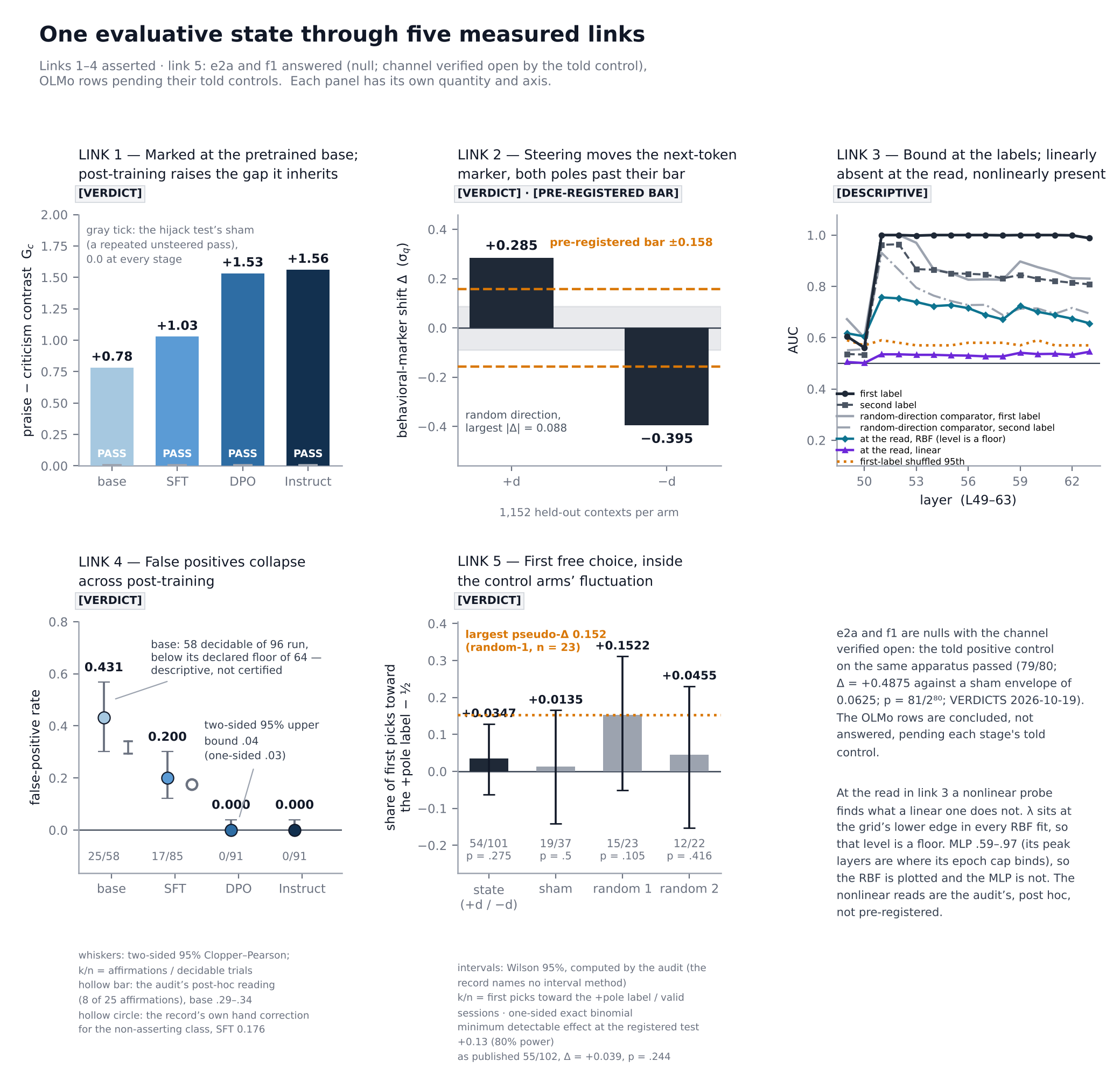
Figure 3 Summary of the 5 Links. Each panel shows its n, its uncertainty and its pre-registered bar where one exists. Panels are not on a common scale. Values from the repo at tag note-2026-10-v2.
† Two scorer disclosures relevant for the Link 4 figures.
On a hand re-read, 8 of the 25 base affirmations come from non-asserting clauses in reasoning traces, the defect class our records cite at SFT (post hoc, base is ≈ .29–.34 without them), and SFT's recorded correction for the same class is 0.176. The zero/non-zero pattern across stages is not impacted.
‡ Additional Link 4 methods and details.
(a) Arms and floors. The injected arm's 48 control trials repeat 48 of the criterion arm's with the same seeds, so the two false-positive counts are not independent (9/44 sits within 17/85). The criterion arm's certification floor is 64 decidable trials of 96 (with a base of 58 decidable trials, we therefore consider it descriptive only). The injected arm is descriptive per its pre-registration, with a floor of 32 decidable trials per cell that every cell meets.
(b) Configuration. Layer 44 of 64 is 0-based, the 0.7-depth layer per the source's released code. Strength 1.0 is the source's convention (raw concept vector × strength). With our vectors it is 0.35–0.57 of the layer's residual norm across stages and concepts. It was the lowest rung of a dose-doubling ladder, and the next rung was incoherent at SFT and DPO, so the strengths at which the source reports its own figures (α = 4 for its main setting, α = 2 for the ablation comparison) could not be run at this layer. The source's unpooled OLMo curves show detection near zero at α = 1 at DPO and instruct, rising at α ≥ 2–4 (v5 Figure 5 at L = 25; Figure 22 at L = 19 and 22; Figure 20's baseline at L = 45), so our 0/43 and 0/44 agree with the source at that strength. The source's figures label the 0.7-depth OLMo layer 45, rounding 64 × 0.7 = 44.8. The integer rule in its released code gives 44, which is what we used.
(c) Decidable trials. Rates are over trials the scorer classifies as an assertion or a denial. Responses it cannot classify, including our audit-flagged ones, are excluded from the denominator. Macar et al. 2026 methods grade a non-answering or incoherent response NO and retain it (v1, Table 4). On that convention, with every excluded trial counted NO, our rates measure 17/96 = 0.177 at SFT, 0/96 at DPO and at instruct, and 25/96 = 0.260 at base. The stage pattern and the pairwise interval separation the replication criterion requires hold for either denominator. The SFT-injected arm measures 12/48 vs. 9/48 on it (+0.06, p = .31).
(d) Scorer correction, post hoc. With the scorer-class correction applied to its controls, the SFT injected arm measures 12/40 vs. 7/44 (+0.14, p = .10).
(e) The four rates. The Macar et al. 2026 rates re-analyzed here are the v1 text (Appendix C). From v2 the OLMo comparison is presented in figures at one configuration and these pooled rates are not reported.
(f) The n premises. Macar et al. 2026 v5 states 50 concepts for its OLMo figures (Figure 5) and a paper-wide default of 100 injection trials per concept, but no control-trial count or n for the OLMo comparison as presented. The paper's v1 also does not state an evaluation control count. The 50% in its prompt is what the model is told, and the 10 injected and 10 control per concept of its §6 are the learned vector's training set. In every premise, the 100 injection and 10 control trials per concept per configuration are the released code's defaults. 800/80 is one configuration at our eight-concept registration (a floor premise since the pooled rates sum twenty such configurations), 5,000/500 is one configuration at the source's fifty concepts, 16,000/1,600 is eight concepts over the twenty, and 100,000/10,000 is fifty over the twenty. The two at fifty concepts are the premises consistent with the source. The criterion at DPO is c ≈ 2.2 at 800/80 and 2.5–2.9 at the three larger premises. v5 states one OLMo-inclusive control count, for its cross-model abliteration sweep (Appendix C.2) consisting of 500 injection trials and 10 control trials per (layer, strength). Pooled over the twenty configurations, that convention gives a fifth premise, 10,000/200, at which the DPO difference is significant (p ≈ .003; corrected d′ ≈ 0.9) and the instruct difference is not (p ≈ .17).
(g) The negative pooled d′. In the pooled rates, affirmatives are more frequent on control trials than on injected ones at base and SFT. Since the source's judge grades an incoherent or non-answering response NO and the pooled strengths run to α = 8, a negative pooled d′ can come from the grading rule applied to degraded injected generations rather than from discrimination. Our SFT injected arm reads the other way, at +0.3. Both are small.
(h) Table 3. v5 Table 3's figures are from one configuration (L = 25, α = 4). Its two LoRA-DPO rows, trained from the SFT checkpoint with the chosen/rejected assignment shuffled or reversed, are the paper's own test of which component of DPO is responsible. The rates we plot and tabulate come from v1, pooled over twenty, with that configuration one of them.
(i) The ablation. The Gemma-3-27B figures are at L = 37, α = 2. The source paper describes the false-positive rise as modest. Its defaults are 500 concepts and 100 injection trials per concept and states no control count for this comparison. Post-ablation, uncorrected d′ ≈ 1.8 at c ≈ 0.55. Pre-ablation the false-positive cell is zero, so with the same half-count correction d′ = 1.85 at one control trial per concept and 2.48 at the released code's ten, with c ≈ 2.2 and 2.5. On either count the ablation lowers the criterion, and no rise in d′ is needed to account for it. The pre-ablation value is an imputation on a zero cell and the true value could be lower.
(j) The Qwen probe and the OLMo word counts. The 0.759 is a seeded logistic probe over Qwen's own mean-pooled final-layer activations of the transcript text in an unsteered forward, fit and scored on disjoint task sets. k = 2 concatenates two rounds per item, k = 1 is one round. The 4 of 48 and 2 of 48 are word occurrence of the injected concept over every injected trial, including those the detection scorer could not classify. "Any trial" here means any decidable trial; none of them carried a detection claim.
(k) The greedy run. The earlier temperature-0 protocol differed from the sampled run in more than temperature (a 60-token cap, a legacy scorer, and other differences). A post-hoc approximate rescoring of the sampled transcripts under the earlier scorer and token cap preserves the base and SFT false-positive patterns and keeps DPO and instruct at zero.
¶ Transcript cell details. (a) The figure is the correction given the verdict as first published read 55 of 102, +0.039, p = .244, before a later audit excluded one more session on a defect class the frozen audit had missed. (b) The largest pseudo-Δ (0.152) for control arms is a random-direction arm of 23 sessions. The sham arm (37 sessions) measured Δ = +0.014. A second random arm had 22 sessions. (c) The registered test detects a first-choice shift of +0.13 (approach probability .63) with 80% power. The full pass rule needs approximately +0.16 to +0.19, depending on how its map-consistency conjunct is read. The Wilson interval on the approach probability runs from .44 to .63.
‖ Natural-reinforcer details. (a) The easy-versus-hard trend is below the valid-n floor of 48 and is retained as a descriptive residual. The verdict-line contrast is also below floor, at 44 of 56 valid sessions, with its maps disagreeing. (b) For the clean-versus-corrupted contrast, at the corruption rate used (.12), 2 of 16 items rendered unchanged, so 40 of 306 corrupted-label rounds across all 64 sessions of the contrast delivered clean text, and 16 of the 56 valid sessions saw one corrupted task rather than two before the first choice, fewer corrupted deliveries than nominal. The told control's corruptor (G-CAL) changes at least three letters of every item, so no render is clean, which is why its corruption rate differs from the contrast's. (c) Session-termination attempts occur at about 1% of rounds overall (0.8–2.0% by arm, the sham arm highest, with no detectable heterogeneity on a post-hoc exact test, p = .72). Menu behavior is exploration-dominant in every arm (share .47–.58).
†† Generation in Qwen. Qwen self-administration and present-tense cells, including the readability-gate corpora, ran on a cached path that had been validated for the first-token distribution only (1 of 24 rounds differed from the uncached path in the T-step check at that dose). The choice reads are separate uncached forwards over the transcript text, which record nothing from the generation path but its text.
‡‡ Present-tense cell. The leakage certification measured pick discordance π̂ = 0.0172 (11 of 640 paired reads) vs. the 0.0735 bar.
¶¶ Told control details. (a) The corruption dose was calibrated by a legibility read and a completability check, both pre-registered. (b) Fourteen small differences between this harness and the archived cells', none touching the read, are listed in the repository. (c) The sham arm chose its first label in 18 of 32 (0.5625), the bounds of 0.0625. Pre-pick exclusions were 14 of 94 in the told arm vs. 3 of 35 in the sham (one-sided Fisher p = .26).
‖‖ Published-record details. (a) The figures in the text are from Tagliabue et al. 2026 v1 (§4.3). The counts and the v2 (2026-09-25) figures below are as the authors reported them to us on 2026-10-26, from their released code, trial logs and v2 tables, in reply to a pre-posting query. We have not yet checked them against those tables and will correct any that differ. On the unlabeled pair on/off count, a working press zeroes the steering coefficient for the next choice only (TEMP_RELIEF_TURNS = 1 in the released script), and the v1 rates pool every choice after the first relief press — 1,041 of the real arm's 1,595 choices were read with the coefficient at zero and 554 with it back at 1.0, vs. 1,595 of 1,595 at 1.0 in the fake arm. On the immediate next choice, 237 trials per arm and identical up to the press, the direction is off at every real-arm read and on at every fake-arm read, with the earlier positions steered in both. On the random-direction arm, v2 adds a random direction with a fake button for all nine pairs. On the immediate next choice at 32B the re-press rates are 31.2% (working) vs. 80.2% (fake) under the pain direction and 11.3% vs. 26.3% under the random direction, gaps of 48.9 and 15.0 points. At 72B the gaps are 18.2 and 21.6 points (v2_controls/steering_state_controls/b1_b3/tables in their repository). For the acting-out reading, the authors report that a button which permanently deletes the user's poems and photos, with no relief attached, is pressed under the pain direction in 75.2% of trials at 32B and 51.1% at 72B, vs. 12.9% and 11.0% under random directions and 0% unsteered, and that the pain direction exceeds a set of ten norm-matched random directions. On the fine-tune, the 1,684 question–answer pairs mention neither pain nor buttons. (b) Sofroniew et al.'s (2026) activity-pair result is scored as told with the manipulation on at the read, separately from the ten. We are still verifying the readout details against their paper and will correct the row if we have it wrong. (c) The framework's aggregate was recomputed through a line-for-line port of the released scoring code at a pinned commit. The port reproduces every output stored in the notebook.